
HEIDENHAIN ROTARY ENCODERS
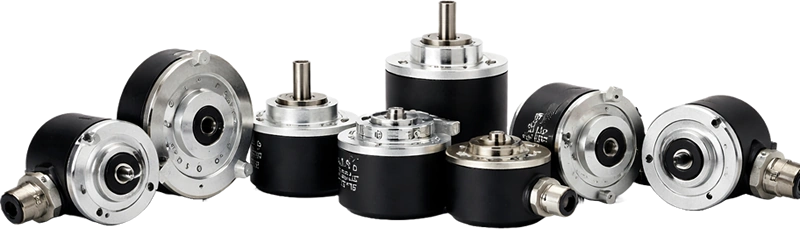
A rotary encoder is an electromechanical device that converts the angular position or motion of a shaft or axle into an analog or digital signal. Encoder couplings connect two shafts at their ends to transmit torque and to compensate for minor misalignments.
Measuring angles with rotary encoders
In Heidenhain rotary encoders with an integrated stator coupling and bearing, the graduated encoder disk is mounted directly to the shaft being measured. A ball bearing guides the scanning unit on the shaft while the stator coupling supports it. The stator coupling only absorbs the torque caused by bearing friction during shaft acceleration, which reduces both dynamic and static measurement errors. Axial motion of the measured shaft is compensated by the coupling mounted on the stator.
Key advantages of stator-coupled designs:
- Very simple mounting
- High natural frequency of the coupling
- Short overall length
- Option for a hollow through-shaft
Angle encoders — accuracy and applications
Heidenhain angle encoders deliver very high accuracy and precision, often in the arc-second range. Common applications include:
- Spindle heads on machine tools
- Rotary tables on machine tools
- Printing units
- C-axes on lathes
- Gear testing machines
- Telescopes
- Spectrometers
There are several mechanical-design principles for angle encoders:
- Angle encoders with integrated stator coupling
- Angle encoders with an integral bearing
- Angle encoders with a hollow shaft
Because the stator coupling only absorbs torque produced by bearing friction during acceleration, these designs offer excellent dynamic performance. Product families such as RCN, RON, and RPN (optical/absolute encoders) provide outstanding dynamic characteristics. When a stator coupling is incorporated, system accuracy also depends on deviations introduced by the shaft coupling.
More practical advantages:
- Compact form for limited installation space
- Hollow-shaft diameters available to accommodate power cables
- Simple mounting procedures
Angle encoder types — details
Angle encoders with integral bearing
Models with an integral bearing (for example, certain ROD encoders with a solid shaft) are suited to applications that require high shaft speeds and looser mounting tolerances. Their shaft couplings typically permit axial tolerances around ±1 mm.
Angle encoders without an integral bearing
Modular angle encoders (such as ERA and ERO families) without integral bearings are designed for integration into machines and assemblies. They are well suited for:
- Segment solutions
- Very high shaft speeds (up to 40,000 rpm)
- Large hollow-shaft diameters (specifications vary; consult the product datasheet for exact limits)
Modular magnetic encoders
Robust modular magnetic encoders (ERM series) are particularly suitable for manufacturing environments. Their large available inside diameters, compact dimensions, and rugged design make them ideal for:
- Spindle direction sensing on milling machines
- The C axis of lathes or other auxiliary axes
- Rotary and tilting axes
Typical Applications
C axis on lathes
Modular encoders (ERM family) are often ideal for C axes on lathes because their large internal diameter allows bar stock to pass through without obstruction and they resist contamination. Using the right encoder reduces position errors and improves machining accuracy.
Rotary and tilting tables
Tilting axes and rotary tables require encoders with high signal quality for precise position and speed control. Optical-based encoders (for example, some RCN series models) meet these high demands. For moderate accuracy needs, magnetic modular encoders are a good alternative: they tolerate contamination, offer large internal diameters, and provide stable axis-speed performance. For example, ERM encoders with a small signal period (e.g., 200 µm) show low position error within one signal period and support high speed stability.
Spindles on milling machines
Spindles are critical components that strongly influence machine-tool performance. Encoder selection affects speed measurement and control. Some ERM models are rated for speeds above 40,000 rpm; other models (e.g., ERM 2400 series with a 400 µm signal period) prioritize higher accuracy and precision.